TAG'S

Mostrando entradas con la etiqueta UNIT 1. Mostrar todas las entradas

jueves, 11 de diciembre de 2014

FROM READING TO WRITTING


From reading to writing

How to make it more easier, how to make it simple


Reading provides a scaffold for learning to write and it is frequently appropriate to teach reading and writing in an integrated way, both in the initial stages and when children have more developed skills.
First with a balanced reading programme:  It is based on sight words. 
Sight words are words that are recognized as wholes, on sight. To learn a sight word, the students must: 
  1. See the word in context many times
  2. Hear the word and say it aloud
  3. Identify the word, in context and in isolation

Through intensive and extensive reading they can get a vocabulary development. For example, we can makes word walls or semantic mapping, a class dictionary, word buildings (phonics)…
A balanced writing programme: Comprehension strategies
Different approaches:
  1. Linear approach: Comprehension takes place through progressive analysis of small units beginning with the word and ending in the sentence. 
  2. Psycholinguistic approach: Emphasizing the paragraph as basic text unit and focus on mental process leading to global comprehension.
  • How teachers can do in class:
  • Draw in / activate students’ prior knowledge
  • Develop students’ awareness of clue-searching strategies
  • Select text based on students’ interests and knowledge and make comprehension an integrated part of the curriculum
  • Use different reading materials (including readers) and design a variety of tasks for different purposes

Remember to do always something special for them, they have to learn in an active way 
Ester C.

lunes, 1 de diciembre de 2014

THE AWSOME WORLD OF MULTIPLE INTELLIGENCES

Today is... Multiple Intelligences turn!

Do you know something about them? Is this real or only a new version of common intelligences?

Everyone is able and everyone is more intelligent is some areas than others, the perfection in humans doesn't exist!

Why we call it: Multiple Intelligences? Who, when, and why someone creates this?

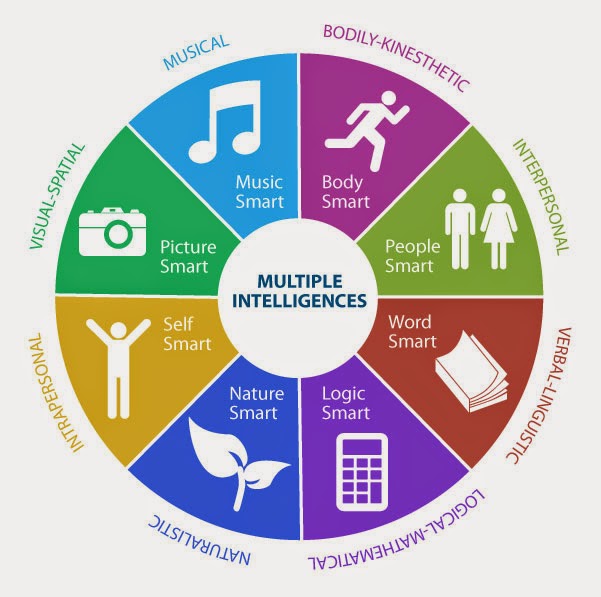
The creator of "The Multiple Intelligences" was Howard Gardner a very important psychologist, who has identified eight distinct intelligences. This theory has emerged form recent cognitive researches.
In 1991 Howard Gardner declared as his theory that: We are all able to know the world throught language, logical-mathematical, spatial representatio, musical thinking, the use of the body to solve problems or to make things, an understanding of other individuales, and an understanding of ourselves". 

In other words: Intelligence is the ability to solve problems everyday, is also the ability to generate problems and create effects and  making solutions and creates or offer services within their own cultural sphere.


This eight multiple intelligences are:


Linguistic, Logical-Mathematical, Visual-Spatial, Bodily-Kinesthetic, Musical, Interpersonal, Intrapersonal and Naturalist.


  1. Linguistic: Using language to present your ideas, to express your feelings, or to persuade others. Some actions about this MI are: Read, Write, Talk and Listen.
  2. Logical-Mathematical: Reasoning, logical thinking, handling mathetical problems. Some actions about this MI are: Quantify, Think critically, Reasoning, Experimenting.
  3. Visual-Spatial: Creating and interpreting visual images, thinking in three dimensions. Some actions about this MI are: See, Draw, Visualize, Color, Map.
  4. Bodily-Kinesthetic: Feeling and expressing things physically, doing hands-on works. Some actions about this MI are: Building, acting, touching, moving and dancing.
  5. Musical:  Creating and feeling rythm to express a mood, detecting and analysing music themes. Some actions about this MI are: Singing, making raps, Play musical intruments, druming ryhtms.
  6. Interpersonal:  (Between people). Understanding the         feelings, needs and purposes of others. Some actions about                                                            this MI are: Sharing, Teaching, collaborating, interacting.
  7.  Intrapersonal:  (Winthin self) Understanding your interior own, thoughts and feelings in a different way and very clear way. Some actions about this MI are: Connecting to ourselves, making authentic choices and decisions; and constantly reflections about ourselves.
  8. Naturalist:  Understanding nature, seeing patterns in the way nature works; classifaying things. Some actions related to this MI are: Experiences with loving nature, care for nature and explore.
So know we know more about this interesting theory is time to apply this information into a practical way:


HOW WE CAN DEVELOP MULTIPLE INTELLIGENCES IN YOUNG LEARNERS WITH TELLING STORIES?

Telling a story we can develop Multiple Intelligences here there are some simple activities related to storytelling, you can do it whenever you want in the pre-telling, telling or post telling.

Linguistic:  We can: -Look for verbal threads.
                                 -Defining the meaning of  some key words in the story.
                                -Identify someone in the story who tells a story or otherwise demonstrates having                                   verbal skill, lack of verbal skill, or a change in verbal skill.

Logical-Mathematical: -Are the chunks subdivided? 
                                     -How many sentences in each part?Look for numbers in the story
                                -In the story of The Three little pigs, We can count how many times the wolf                                          blows in each house...
                                - Identify the way a character in the story use logical argumentation or thought.                                      (Why the big pig instead of playing he wants to build his house?) 

Spatial-Visual: -Use modeling material, blocks, or clothespins to create figures representing the                                     characters.
                        -Define geographical areas or features with boxes, cloth or whatever is handy; position                         the figures in relation to one another at different points in the story.

Musical: -Sing a song related to the story. 

Interpersonal and Intrapersonal : -Talk about the main character of the story how is his/ her mood is                                                he/ she friendly? What are the characteristics of someone who is                                                             friendly?

Naturalistic: -Go to the zoo and identify the different animals . How do they differ? How are the                               same? How these differences affect the animal's relationships with its environment?


Bodily: - Do actions about the story like a "cuento motor" is a story that, children are doing some                       bodily actions of the story.
            

                                                          HOPE YOU LIKE IT! And remember that each is able to do something speacially, everyone is intelligent and unique.

 Ester C.

jueves, 9 de octubre de 2014

SPEAKING: PRONUNTIATION GET SOME CLUES

TODAY IS PRONUNTIATION TIME

         Getting somo clues....

                         Tongue twisters and Jolly Phonics


To speak, it is very important to be understood, the pronunciation. The pronunciation is based centrally in imitation, but we can't do boring classes, or make English classes like repeation classes. So an alternative to those "kinds of repetition" is: apply to the pronunciation puns, maxillary jaw exercises, some theoretical explanation of concepts and lot of practice including tongue twisters.

After imitating the sound and learning the correct biology for producing it, now is the time to practice the use of that sound or sound pattern. You can use minimal pairs (pairs of words which differ in only one sound like mop and pop or pop and pep) to highlight one sound or phoneme that you are teaching. If you want to add a little fun to pronunciation class, try tongue twisters. There is no end to the tongue twisters you can find or write, and not even native speakers are good at them, so the pressure is off your students to perform flawlessly.  You can also teach the natural rhythm of English through songs and poetry. 

A tongue twister that I really love is: "I saw Susie sitting in a shoe shine shop. Where she sits she shines and where she shines sits".


I would like to speak also of a reality that is done in some bilingual schools to teach pronunciation and phonetics without using the typical picture of phonetic alphabet.

JOLLY PHONICS BOOK'S

JOLLY PHONICS METHOD

What is Jolly Phonics and whats's his relation to pronuntiation?

Jolly Phonics is a fun and child centred approach to teaching literacy through synthetic phonics and pronuntiation. 

With actions for each of the 42 letter sounds, the multi-sensory method is very motivating for children and teachers, who can see their students achieve. The letter sounds are split into seven groups as shown below.

It's a very lovely method and very systematic and also it's an approachment to the music they are having fun but they are learning pronuntiation and phonetics too. This method have so many educational and fun materials apart from the sons about each letter of the alphabet.


A simple example for the first group of letter in the order that is teach:


                                                     Have fun and have a good pronuntiation! Remember our students are listening to us everyday and everywher!


Ester C.

miércoles, 8 de octubre de 2014

UNIT 1: REFLECTIONS- LISTENING AND SPEAKING

HI EVERYONE! 

Today we are going to speak about...

LISTENING AND SPEAKING

Sometimes we want to our students to listen and then speak like we do it but how to do this in a different way?

Today I will talk about how to get some fun and interesting skills that we saw in class. As through two videos, one a story and a song we can work around this. I'm going to show you the story and the song and then I will give you some ideas some suitables games and activities (like exercises) to work hard in listening and speaking.

  • THE VERY HUNGRY CATTERPILLAR:

The Very Hungry Caterpillar is a children's picture book designed, illustrated and written by Eric Carle. It features a caterpillar who eats its way throught a wide variety of foodstuffs before pupating and emerging as a butterfly.


With this story we can work : the numbers, the development of the caterpillar to butterfly , food , days of the week, the antagony of night and day (sun and moon) and finally the concept of hunger or what it means to be hungry .

Some suitable activities and games for how to learn Speaking:

-True or False: After hearing the story the teacher may ask questions of understanding the story . They must speak and tell what they have understood, justifying each answer. If the students are older (5 years) we could ask them to do it themselves questions or to their class-mates.

-The sentence round or Describe and draw: There are also two more activities very suitables to do after the very hungry catterpillar.

Some suitable activities and games for how to learn Listening:

-Mime what happened.
-Listening grids
-Questions gallery


  • SIMON SAYS:

Singing it's a very nice and practical way to work the pronuntiation:
My reflection of this is that we have to:
Give our students the main opportunity that is to imitate, they also are reviewing the parts of contains and they make appropriate English sounds
With this Simon Says version we can teach: the parts of the body, actions, and music instruments.
"Debbie & Friends" recorded a live concert at Berklee College of Music's CAFE 939 in Boston. Here there are performing their "Simon Says" game song. We had a great time sawing it in class! 


Some suitable activities and games for how to learn Speaking:

-Sentence round
-Three things about me (about the game-song)
-Find a friend who can (actions from the game-song)
-Agree or desagree (some statements about the Simon says)

Some suitable activities and games for how to learn Listening:
-The Gym sequence 
-Listen and respond
-Colour dictation
Follow the route.
  

                                                                 Hope you liked it as I liked!                               Ester C.

viernes, 26 de septiembre de 2014

UNIT 1: LISTENING AND SPEAKING - READING AND WRITING


This blog is divided into various units.


This first unit comes on as the title says: Listening and speaking (including pronunciation) on the one hand, and reading and wirting on the other side.

This entry is therefore explanatory so what try the following entries, which revolved around this Unit 1.

Hope you like it, this unit is full of thoughts, many ideas and content.

Ester C.